

Health Empowerment Alliance of Long Island (HEALI) is Long Island’s Social Care Network, led by Health and Welfare Council of Long Island, and integrates health and social care providers serving Nassau and Suffolk Counties. To join as a CBO partner or to find resources, please click here

Policy & Advocacy
We work with local, state, and federal government partners to advocate for effective policy decisions that will impact our neighbors and hometowns.

Coalitions & Grass Roots Organizing
We bring together nonprofits, business leaders, and lawmakers to discuss solutions to our region’s challenges.

Direct Services
We operate a series of programs that connect Long Islanders with the services they need.
Welcome to the Health & Welfare Council of Long Island
At the Health & Welfare Council of Long Island (HWCLI), our work is to ensure that our region is a welcoming and inclusive place for everyone to live. We can set the standard for what an equitable region looks like. That means safe communities, decent, affordable housing, healthy food, access to care and an opportunity to thrive. In our quest for improvements and systemic change, we face a unique set of obstacles. In fact, the poverty rate today is at its highest since 1959. Given the current assault on the country’s most vulnerable communities, our work is more important than ever.
Our Impact
11350 |
People served in 2023 alone |
 |
76 |
Years Serving Long Island |
 |
200+ |
Partnering Organizations |
|
Recent News
December 15, 2025
'We really can't afford it': Health insurance costs to spike for Long Islanders in 2026
By Brianne Ledda
Updated December 15, 2025 3:46 pm
Read on Newsday
Virginia and Michael McGrath were surprised in late November when the retired West Islip couple got a letter notifying them that their health insurance bill would rise about 20% next year.
Their plan with EmblemHealth will cost $862 per month starting Jan. 1, $140 more than their current monthly premium.
“We really can’t afford it,” said Virginia McGrath, adding that the couple, who are both in their 70s, will have to figure out how to manage the extra cost. Virginia is scheduled for an important surgery in January — and the McGraths believe it would be a bad time to "shake up" their coverage.
They are among millions of Americans, including Long Islanders, contending with higher health premiums taking effect in the new year as prices rise across coverage types.
WHAT NEWSDAY FOUND Higher health care premiums will exacerbate an existing affordability crisis for Long Islanders, hitting especially hard for middle and lower income households already feeling the squeeze from inflation and tariffs, economists say. Hikes in both public and private plans could lead to reduced consumer spending and an increase in individuals choosing to forgo health plans — a risk that could lead to even higher premiums down the line, policy experts said. The potential expiration of enhanced tax credits adds to the burden of rising prices particularly through plans under the Affordable Care Act, with some paying hundreds more per month.The surge adds another pressure point to increasingly strained household budgets. Some policy holders might even drop coverage altogether, especially younger people with fewer pressing health needs, experts said.
Higher premiums "will result in cutbacks in overall spending,” especially among middle- and low-income families relying on tax credits to cover plans through the Affordable Care Act, said Martin Melkonian, an economist at Hofstra University in Hempstead.
“I think there are many folks living on the edge at this moment," Melkonian said.
Without action from the federal government, enhanced premium tax credits under the ACA are set to expire at the end of 2025, further increasing out-of-pocket costs for many consumers.
Rising premiums on Long IslandMost Long Islanders have some form of health insurance — 96.2% in Nassau County and 95.3% in Suffolk County, according to census data. The 28,000 Long Islanders who use federal tax credits to help cover costs for ACA plans stand to take the largest hit, with an average 32% price increase in 2026, in addition to the loss of income-based enhanced tax subsidies.
Premiums are also rising for other plans, including Medicare and employer-sponsored insurance, fueled by hospital consolidation, an aging population and increased expenses for medical services, among other things, Newsday has reported.
A September survey estimates employer insurance plans will go up 6.5% on average in the highest increase since 2010, Newsday has reported. The more than 1,700 employers who participated in the survey from Mercer, a Manhattan-based consulting firm, estimated that without cost-saving measures, average benefit costs would rise nearly 9%.
In New York, businesses with 100 or fewer employees on small-group plans will see an average 13% increase, while nongroup, individual-based plans will rise 7.1% on average, according to a Newsday analysis. The state Department of Financial Services approved some of the largest hikes in years for state-regulated plans, though the agency said the increases were still significantly lower than what insurers requested, Newsday has reported.
Meanwhile, Medicare premiums will rise around 10%, according to the Medicare Rights Center, a consumer advocacy nonprofit.
The cost increases “might mean that some people have to pick up an extra job to be able to meet their health insurance premium, dollars-wise,” said Matthew McGough, a policy analyst at KFF, a nonprofit health policy organization.
Some may choose lower-cost plans with higher out-of-pocket expenses while others, especially young and healthy individuals, might choose to forgo individual insurance plans entirely, a decision that could lead to higher overall health premiums down the line, he said.
People putting more money toward bills means less disposable income reentering the local economy, especially in places with high costs of living like Long Island, said Steven Kent, chief economist for the Long Island Association.
Chris Reilly, 80, of Manorville, is concerned that yearly increases to his Medicare premiums in recent years have outpaced yearly cost-of-living adjustments to Social Security checks, which, along with savings, he uses to pay his bills in retirement.
“Anybody who’s on Social Security, their Social Security increase gets practically totally consumed just by premium increases related to Medicare,” Reilly said.
Impact on small businessesThe loss of enhanced tax subsidies at the end of the year will especially hurt small business owners, along with middle-class households more broadly, many of whom qualify for and rely on the federal tax credits, said Vanessa Baird-Streeter, CEO of the Health and Welfare Council of Long Island, a regional nonprofit that provides community services.
“People are going to be making these choices between, ‘What am I eating? Am I paying my insurance? Am I paying my mortgage?’” she said.
Households with income up to 400% the federal poverty line — $124,800 for a family of four — qualify for tax premiums, according to the Center on Budget and Policy Priorities. Even those making more than the cutoff may qualify for enhanced credits if their ACA premium exceeds 8.5% of their household income.
Nearly half of adults under 65 enrolled in individual market coverage through ACA are connected with small businesses — either as an employee at a business with fewer than 25 workers, as a self-employed entrepreneur or as a small business owner, according to a KFF analysis.
With ACA premiums rising as much as 50% for some on Long Island, according to Baird-Streeter, it’s an added expense for small businesses already struggling with higher costs from inflation and tariffs.
“Long Island is made up of Main Streets,” she said. “We’re talking about our local downtowns, and those are small business owners that are going to definitely be hit.”
Small businesses make up around 90% of businesses on Long Island, Newsday has reported, employing hundreds of thousands of workers.
Health insurance premiums already rival rent costs for some small business owners, said Joseph Garcia, vice president of the Nassau Council of Chambers of Commerce.
“It already was stifling small business creation and success," he said. "[The increases] aren’t going to help.”
There’s a concern that higher premiums could reduce entrepreneurship on Long Island by holding back people from striking out on their own to start businesses, Kent added.
Higher premiums could also drive existing small business owners to seek more stability through an employer sponsored health insurance plan at a different job, McGough said.
Part of the problem for small business owners, and Long Islanders in general, is the ongoing uncertainty about what’s going to happen with ACA subsidies, Kent said.
On Thursday, the Senate rejected legislation to extend ACA subsidies for another three years, along with a Republican alternative that would have created new health savings accounts instead.
December 4, 2025
Many Long Islanders struggle to keep heat on as cold temps set in
Posted on December 4th, 2025
Watch/Read on News 12
By Jeremy Skiba
As cold temperatures settle in across Long Island, many residents are struggling to keep their homes warm — and delays with the Home Energy Assistance Program (HEAP) have only added to the stress.
Quanisha Chambers says she has relied on HEAP benefits for several years to keep her home heated during the winter. But when the program’s application opening was delayed, her family grew concerned.
“It was a little bit rough. We had to turn on the stove to heat up a little bit. Other than that, we made it through,” Chambers said.
She added that the program has significantly eased the financial burden of heating her home.
“It has helped tremendously," Chambers said. "The expense is really high, and it helps to have HEAP.”
Chambers works at Angels of Long Island, a nonprofit that has been distributing heaters to families in need as temperatures continue to drop.
The HEAP application finally opened on Monday, but many Long Islanders attempting to apply were met with an error message.
“We need heat for our young children. We have some people that can’t provide heat. Children need that heat, and without it, it would be hard to survive out here,” Chambers said.
The program was originally slated to open in November, but the federal government shutdown pushed the launch to December, creating a backlog of applicants.
“That’s an overwhelming burden on your local Department of Social Services because now they have all these applications coming in,” said Vanessa Baird-Streeter, president of the Health and Welfare Council of Long Island. “Starting on Dec. 1, how are they going to expedite those applications so people will have access to the benefit?”
Baird-Streeter added that HEAP is especially vital on Long Island, where the cost of living, including utilities, remains high.
“Our utilities are expensive. Our natural gas is expensive. Oil is expensive. Any benefit that can subsidize those costs is needed in the Long Island region,” she said.
News 12 has reached out to the New York State Office of Temporary and Disability Assistance about the website issues but has not yet heard back.
November 17, 2025
Health summit in Bridgehampton promotes empowerment for women
By Tara Smith
Updated November 15, 2025 7:06 pm
Read on Newsday
Swaddling her newborn son against her chest, Randalle Lewis recounted her terrifying ordeal after being diagnosed with a subchorionic hematoma in the third trimester of her first pregnancy in 2019.
Heavy bleeding prompted Lewis, 37, of Wheatley Heights, to seek care at a hospital emergency room. There, a swarm of health care workers peppered her with questions, dismissing her concerns as they began preparing for an emergency cesarean section.
Lewis, who is the advocacy and coalition manager at the Health & Welfare Council of Long Island and is Black, counts herself lucky that she had a network of family, friends and connections that ultimately spared her from the risky procedure and she had a natural birth instead.
The traumatic experience is what led Lewis to opt for a midwife and doula during her most recent pregnancy.
“I educated myself, and it wasn’t easy work. But whatever the thing is that you want, whatever the thing is that’s bothering you, do your research, use your resources and ask questions,” Lewis told more than 50 women who gathered for a summit on women’s health in Bridgehampton, where she was a speaker Saturday.
Turning reluctance and mistrust into education and empowerment for women, particularly women of color, was a key theme of Saturday’s conference at the Bridgehampton Child Care & Recreational Center. The event was co-hosted by the center, the health and welfare council and the Women’s Diversity Network.
Wide-ranging panel discussions focused on women’s health at every stage, blending candid, lived experiences with insights from medical experts throughout the region. Though maternal mortality rates have improved, racial disparities still exist.
Data from the state Department of Health shows Black women are five times more likely than white women to die from pregnancy-related conditions, including excessive bleeding, blood clots and high blood pressure.
Between 2018 and 2020, the statewide maternal mortality rate was 18.5 per 100,000 live births. Among Black women, the rate was 54.7, compared with 11.2 for white women.
“We know there is a history of racial injustice, social structural barriers, the fact that women of color are not listened to,” said panelist Adesuwa Watson, director of the Suffolk County Office of Minority Health. “Our symptoms are trivialized.”
Watson said the county organization focuses on conditions that disproportionately affect communities of color but specifically called for more inclusive medical trials, which could improve health outcomes.
Doctors who were serving as panelists at the conference, agreed, adding that implicit biases and what is taught in medical books can negatively impact patient care and contribute to disparities.
“I only know what eczema looks like on Black skin because of my family,” said Dr. Lucy Moussignac, a Sag Harbor-based physician.
Many providers, who were panelists, said their organizations have added training on implicit bias to help provide more equitable care.
Disparities in health care don’t just impact expectant mothers. Panelists spoke about a range of socioeconomic and cultural barriers that can affect how other issues, from fertility to heart and gum disease and Alzheimer’s disease, are treated, let alone diagnosed.
Women’s Diversity Network founder Shanequa Levin said it’s important to be honest about health care experiences, even if taboo or uncomfortable, to promote changes “so that women in every stage of life, in every ZIP code and every background, cannot only survive but thrive.”
Events
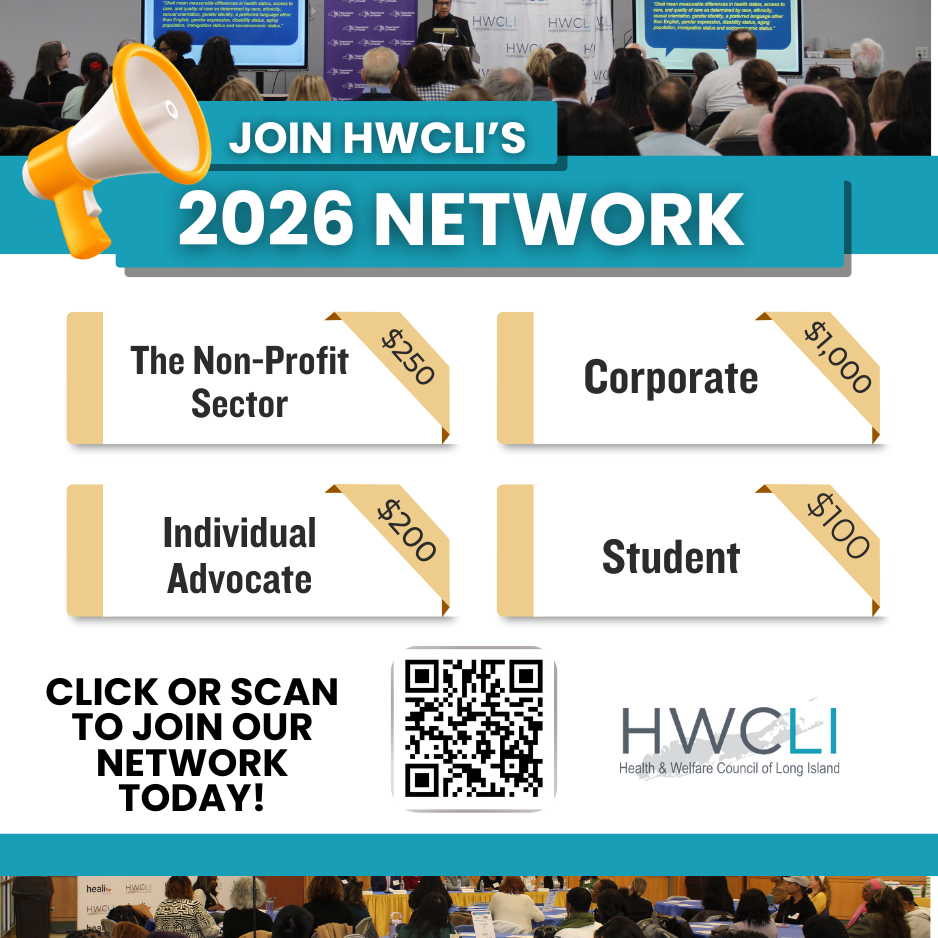
Join us in creating a future for Long Island in which everyone has an equal opportunity to prosper and thrive.
Join Our Network
JoinSubscribe to Our Newsletter






















Established in 1947, the Health and Welfare Council of Long Island (HWCLI) is a regional, nonprofit umbrella organization for health and human service providers dedicated to improving the lives of Long Island’s most vulnerable residents by responding to their needs through the promotion and development of public policies and direct services.


Quick Links
Contact Us
110 Walt Whitman Road, Suite 101, Huntington Station, NY 11746
Phone: 516-483-1110
Fax: 516-483-4794
E-mail: [email protected]
Copyright ©2026 HWCLI. All Rights Reserved. Designed by FBC