

Health Empowerment Alliance of Long Island (HEALI) is Long Island’s Social Care Network, led by Health and Welfare Council of Long Island, and integrates health and social care providers serving Nassau and Suffolk Counties. To join as a CBO partner or to find resources, please click here

Policy & Advocacy
We work with local, state, and federal government partners to advocate for effective policy decisions that will impact our neighbors and hometowns.

Coalitions & Grass Roots Organizing
We bring together nonprofits, business leaders, and lawmakers to discuss solutions to our region’s challenges.

Direct Services
We operate a series of programs that connect Long Islanders with the services they need.
Welcome to the Health & Welfare Council of Long Island
At the Health & Welfare Council of Long Island (HWCLI), we ensure our region is welcoming and inclusive for everyone. We strengthen communities by connecting individuals and families to vital services, supporting nonprofits, and advocating for policies that expand opportunity and well-being. As economic pressures rise and families face unprecedented challenges, our work to create stronger, healthier, and more resilient communities is more important than ever.
Our Impact
35000 |
People served in 2025 |
 |
79 |
Years Serving Long Island |
 |
200 |
Partnering Organizations |
|
Recent News
June 1, 2026
SNAP benefits could end Monday for thousands of Long Islanders
By Tiffany Cusaac-Smith
Updated June 1, 2026
Thousands of Long Islanders could start losing food assistance as soon as Monday because of the Trump administration’s changes to the Supplemental Nutrition Assistance Program.
Roughly 4,850 Nassau County residents considered by the Trump administration to be "able-bodied" could lose access to the federal program, also known as SNAP, as a result of new work requirements to receive benefits.
In Suffolk County, 21,439 residents could be cut off from the program formerly known as food stamps, according to the New York State Office of Temporary and Disability Assistance's December tally.
What led to the SNAP changes?Last year, President Donald Trump signed a sprawling budget bill passed by Congress that made several changes to the SNAP program.
What are the changes?Among the key changes in the law were provisions regarding those considered "Able-Bodied Adults Without Dependents," officials said. Those in that category are restricted to three months of SNAP benefits across three years if they don’t meet work or volunteer requirements, according to the U.S. Department of Agriculture.
New York State previously held federal waivers so that people in that category could continue receiving benefits outside that time period, but most of those waivers have lapsed, officials said. The extensions ended March 1, starting the clock on the three-month timeline ending Monday. The law also makes it harder for states to obtain the federal waiver, requiring an unemployment rate of above 10%. In April, New York had an unemployment rate of 4.6%, according to the federal Bureau of Labor Statistics.
The law also includes increasing the age limit of those who would have to follow the Able-Bodied Adults Without Dependents timeline. Previously, it was limited to those aged 18 to 54. Now, the law has raised the higher age limit to 64, the USDA said.
Who can be exempt, and what are the new work-requirement rules?People considered to be Able-Bodied Adults Without Dependents should meet several requirements, including working or volunteering, the state said.
The work rules also can be met by gaining a job skill, though it must be approved by the local department of social services and be for 80 hours a month, according to the state Office of Temporary and Disability Assistance.
The OTDA said there are several exceptions to the rules, including being pregnant or of Native American descent. Other exemptions may include not being able to work because of a physical or mental health disability, officials said.
The state also recommends reaching out to the Department of Social Services for Nassau or Suffolk for additional assistance for Long Island residents.
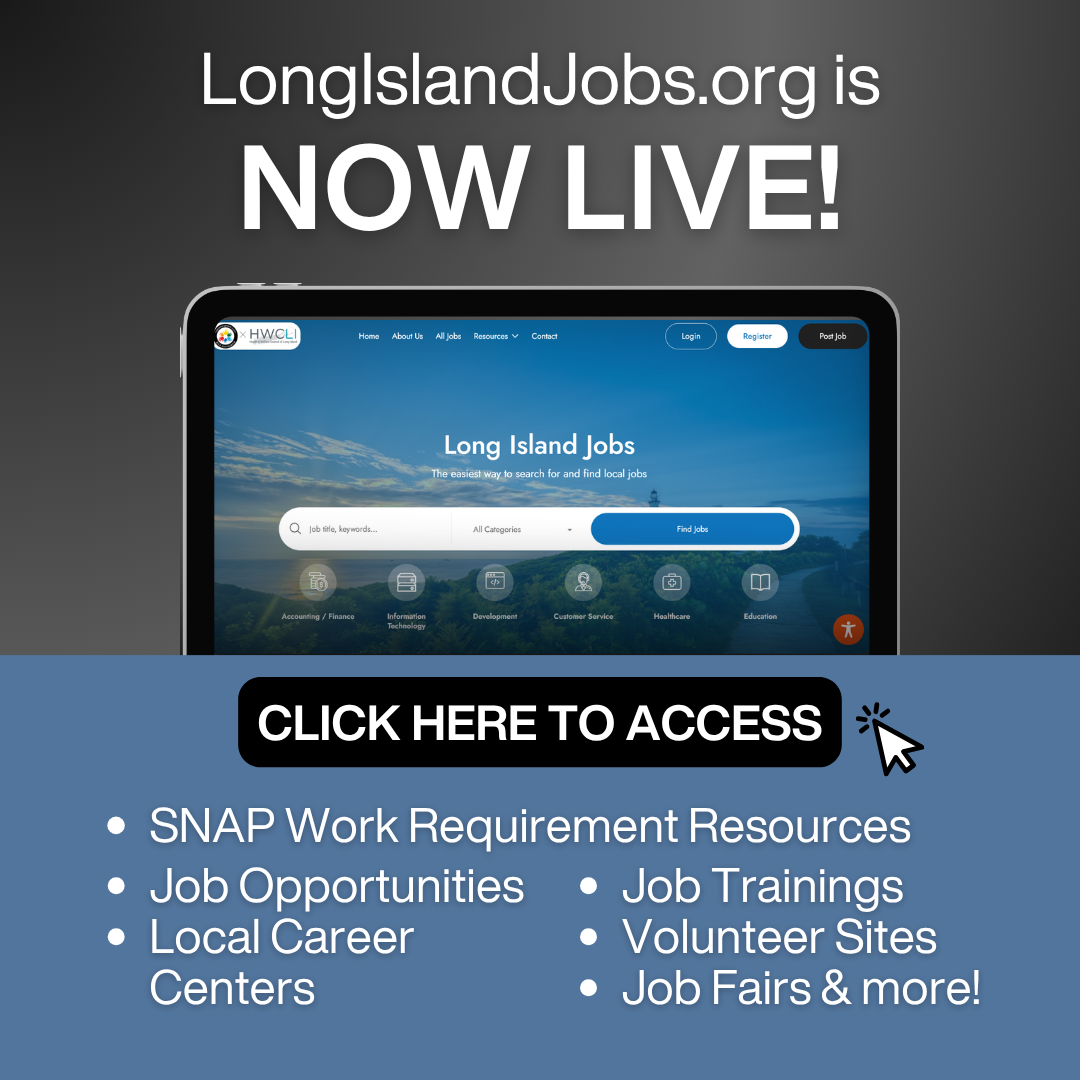
What are other ways to keep benefits?To help Long Islanders meet work requirements, the Health and Welfare Council of Long Island has launched a job website, with the aim of helping those impacted satisfy SNAP work obligations.
The website links job seekers to a prospective employer's website, job fairs and local career centers and provides the forms needed to meet the SNAP work requirements.
"At the end of the day, we're trying to make it as easy for people and remove the barriers for them to fulfill the newly implemented work requirement for those particular subsets of the population," said Vanessa Baird-Streeter, president and CEO of the Health and Welfare Council of Long Island, in an April interview about the SNAP program.
May 19, 2026
Health and Welfare Council awarded $50K Wells Fargo grant for housing needs
By Jared Scot
Posted on May 19, 2026
Read on LItimes.org
The Health and Welfare Council of Long Island (HWCLI) announced it has been awarded a $50,000 grant from Wells Fargo to support immediate housing needs for senior and disabled residents in Huntington Station and across Suffolk County.
Funding from the grant will help the nonprofit to provide critical resources and support services to seniors and individuals with disabilities who are struggling to maintain safe and stable housing.
“We are deeply grateful to Wells Fargo for this meaningful investment in Long Island communities and for their shared commitment to strengthening housing access and affordability,” said Vanessa Baird-Streeter, president and CEO of the Health and Welfare Council of Long Island. “This support directly aligns with our mission to serve Long Islanders by addressing urgent housing needs and advancing solutions that help individuals and families secure and maintain affordable, stable homes, the foundation for health, dignity, and opportunity across our region.”
The grant was announced during the ribbon-cutting celebration for Wells Fargo’s newest Long Island branch at 269 Walt Whitman Road in Huntington Station.
“We’re proud to serve our neighbors in Suffolk County and are truly grateful for the warm welcome we’ve received as we become part of the community and continue expanding our branch presence across Long Island,” said Dan Hoke, business growth strategy executive for Wells Fargo.
May 18, 2026
Huntington Station, NY — The Health & Welfare Council of Long Island (HWCLI) is proud to announce it has been awarded a $50,000 grant from Wells Fargo to support immediate housing needs for senior and disabled residents in Huntington Station and across Suffolk County.
Funding from the grant will support HWCLI’s ongoing efforts to assist vulnerable residents facing housing instability, helping provide critical resources and support services to seniors and individuals with disabilities who are struggling to maintain safe and stable housing.
“We are deeply grateful to Wells Fargo for this meaningful investment in Long Island communities and for their shared commitment to strengthening housing access and affordability,” said Vanessa Baird-Streeter, President and CEO of the Health and Welfare Council of Long Island. “This support directly aligns with our mission to serve Long Islanders by addressing urgent housing needs and advancing solutions that help individuals and families secure and maintain affordable, stable homes, the foundation for health, dignity, and opportunity across our region.”
The grant was announced during the ribbon-cutting celebration for Wells Fargo’s newest Long Island branch, located at 269 Walt Whitman Road in Huntington Station. The newly constructed branch reflects Wells Fargo’s continued expansion and investment in communities across Long Island.
“Wells Fargo’s newest branch in Huntington Station reflects our continued commitment to the people who make this neighborhood and all of Long Island such a special place,” says Dan Hoke, Business Growth Strategy Executive for Wells Fargo. “We’re proud to serve our neighbors in Suffolk County and are truly grateful for the warm welcome we’ve received as we become part of the community and continue expanding our branch presence across Long Island.”
HWCLI remains committed to advancing equity, improving quality of life, and connecting Long Islanders to the resources they need to thrive. Partnerships like this one with Wells Fargo play an important role in helping meet growing community needs across the region.
About the Health & Welfare Council of Long Island:
The Health & Welfare Council of Long Island (HWCLI) is a nonprofit umbrella organization representing health and human service providers across Nassau and Suffolk Counties. HWCLI works to improve the quality of life for Long Islanders through advocacy, direct service programs, coalition-building, and system-wide coordination. For more information on services provided by Health & Welfare Council of Long Island, visit www.hwcli.com, email [email protected], or call 516-483-1110. Connect with us on Facebook, LinkedIn, X or Instagram.
Events
23
Jun
2026
 01:00 pm - 02:00 pm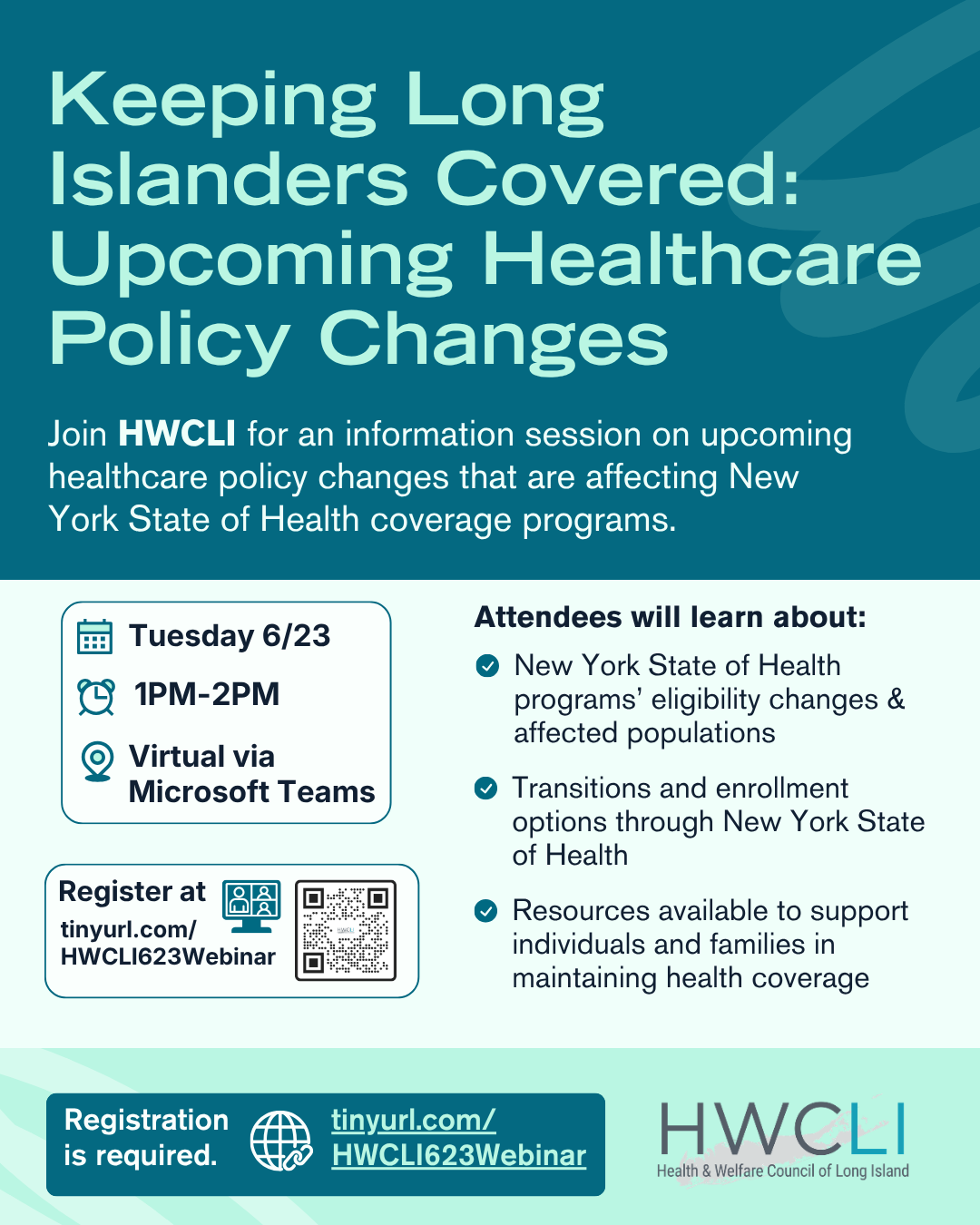
Join us in creating a future for Long Island in which everyone has an equal opportunity to prosper and thrive.
Join Our Network
JoinSubscribe to Our Newsletter





















Established in 1947, the Health and Welfare Council of Long Island (HWCLI) is a regional, nonprofit umbrella organization for health and human service providers dedicated to improving the lives of Long Island’s most vulnerable residents by responding to their needs through the promotion and development of public policies and direct services.

Quick Links
Contact Us
110 Walt Whitman Road, Suite 101, Huntington Station, NY 11746
Phone: 516-483-1110
Fax: 516-483-4794
E-mail: [email protected]
Copyright ©2026 HWCLI. All Rights Reserved. Designed by FBC